


A property is not only rooms. It is rooms, plus a pool that non-residents pay to use, plus a spa with its own appointment book, plus a dive course that runs on Tuesdays. Modelled as four separate listings, a guest who books all four leaves with four reference numbers and four codes, and you reconcile four reports. Modelled properly, the property is one listing: rooms are one kind of thing on it, the pool day is another, the spa is a third, and the guest who books all of it gets one booking, one code and one bill.
What you set per room type
Per room type rather than per property, because a villa and a twin do not sell the same way.
- How many of that room you have, per night, with the calendar showing what is left rather than what was published
- The nightly rate, with seasonal and holiday rates set as dated rules over the top of it
- Minimum and maximum length of stay, enforced before payment rather than apologised for afterwards
- How many guests the room sleeps, and the point at which another guest is charged for
- How far ahead the calendar opens, and how late a same-day booking can still come in
- The dates the room is closed outright: maintenance, a private buyout, the owner's own week
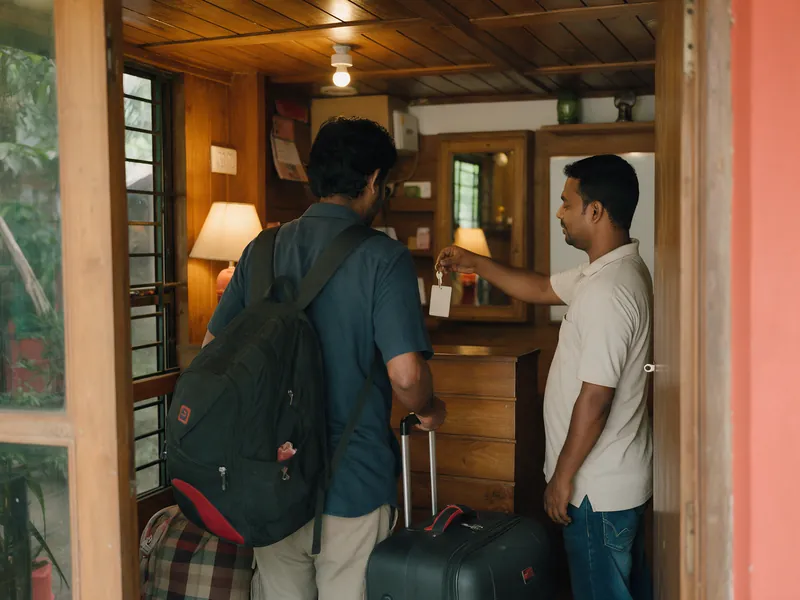
Check-in is where a booking system is judged. Everything before it is a promise.
Arrivals, not bookings
The screen a front desk actually lives on is today: who is arriving, who is leaving, who is already in, and what they have run up. It is ordered by the time things happen, not by when the booking was made, because that is the order the day arrives in.
A guest turns up with one code. Scanning it opens the whole booking (every night, every extra, everyone on it) rather than one line that has to be matched against a printout. Somebody who walks in without a booking is sold one at the desk on the same system, so they are a real booking with a real code and a real confirmation, not a note in a book that nothing else knows about.
The tab, not just the room
Everything charged on site goes onto a folio attached to the booking: the bar, the spa, the boat, the restaurant, a deposit against a key. Each line records who charged it and which vendor it belongs to, so at the end of the month what a concession is owed comes out of the ledger instead of out of an argument. Because each charge is keyed against the booking, a double-tap at a busy bar records one charge rather than two. It is settled on site, and the report behind it exports.
What we need to put a property live
Less than you would expect, and none of it is a data migration.
- Room types, how many of each, and the nightly rate
- Your minimum stay, if you have one, and the dates you are closed
- What else on the property is bookable (pool, spa, classes, boats) and whether non-residents can book it
- Whatever gets charged on site and who collects it, if you want the folio
Common questions
What kind of property is this for?
Anything sold by the night: resorts, guest houses, villas, cottages, homestays and camps. It suits a property that sells more than rooms particularly well: a resort with a pool day, a spa and a dive course is one listing, and a guest who books the room and the spa gets one booking and one code rather than a handful.
Can I set a minimum stay?
Yes, a minimum and a maximum, per room type, and it is enforced before payment: a two-night request against a three-night minimum is refused at the calendar, not after the card has been charged. Both can also be varied for a window of dates, so a holiday week can carry a longer minimum than the rest of the season.
How do rates work across a season?
Each room type has a nightly rate, and dated rules change it: a season, a holiday week, a rate for three nights or more, an early-booking rate. A stay is priced on the rate in force for that booking and held across its nights, so it is worth setting your season boundaries on the dates your price genuinely changes.
Can guests charge things to the room?
Yes. Everything spent on site (bar, spa, restaurant, boat, a deposit against a key) goes on a folio attached to the booking, with the vendor and the staff member recorded on every line. It is settled on site, and takings per vendor for any range of dates export as a report.
What about walk-ins and phone bookings?
Taken at the desk on the same system, so they produce a real booking: a room actually leaves inventory, a code is issued, a confirmation goes out. How it was paid (cash, card machine, transfer) is recorded as it happened, and the booking appears in the same reports as an online one rather than in a separate book.
The rest of what we do

Availability management
Opening times, capacity and closures in one calendar the booking page reads from.
Read more
Guest management
One record per guest, built from the bookings rather than typed in afterwards.
Read more
On-site operations
The gate, the counter and the guest tab, on one code and one ledger.
Read moreTell us about the event
Send your room types, your rates and the dates you are closed. We will build the property, set the calendar and give you a booking page to look at before you commit to anything.
Prefer email? support@quicket.me