


An attraction has one number that decides everything, and most cannot see it until the day is over: how many people are inside, how many are still coming, and what each of them paid. When the gate sells paper and the website (if there is one) sells something else, those are two separate counts that only meet in the evening. Neither of them tells you what a Saturday in the rainy season is actually worth.
The pattern we keep finding
Most mid-sized parks in this region have a Facebook page and a cash box, and the two do not talk to each other.
- Tickets are sold on the day at a window, so demand is whatever turns up and the queue is the whole first impression
- Group and school bookings are arranged by phone and honoured on trust, against a list somebody carries on paper
- Entry-plus-ride packages exist on the price board but not in any system, so what sold is reconstructed from the till
- There is no way to put a price on advance certainty, so nobody has a reason to buy before they arrive
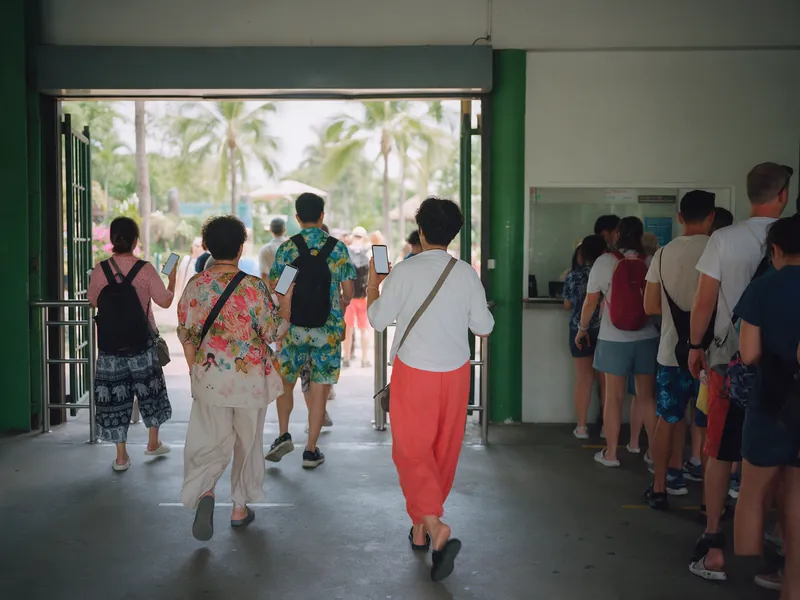
A ride is a fixed cost whether twenty people are queuing for it or two hundred. The gate is where that gets decided.
The gate price and the online price should not be the same number
The one thing the large attractions in this region do consistently is price advance purchase below the gate. Safari World's walk-up rate is ฿1,800 against roughly ฿780–1,130 booked ahead, and that gap is not really a discount: it is what certainty is worth to the operator.
An advance sale is money before the day, a head you can plan staffing around, and a visitor who is no longer deciding on the morning based on the weather. Charging less for it is rational. Doing it safely needs only one thing: that the online sale and the gate sale draw down the same inventory, which is usually the part that is not true.
What you get
Built on the ticketing engine that already runs live events in both countries, pointed at a place that opens every day.
- Day tickets, dated or open, with an advance price and a gate price that are two rules on the same ticket
- Season and multi-visit passes, where you decide whether a code works once, a set number of times, or all season
- Combined packages (entry plus rides, entry plus lunch) as one thing the visitor buys rather than three things they queue for
- Group and school bookings taken as real bookings, with the head count and whatever you need to ask on the record
- One scannable code per booking, so a family of six is one scan at the gate rather than six
- Counter sales on the same system, so the window and the website never disagree about how many are inside
Water parks
A water park is the same problem with a different queue. Entry tickets dated or open, cabana and locker hire as add-ons, a season pass whose code is good all summer, and a wristband instead of a paper ticket because everything gets wet. The one thing worth setting up differently is capacity: a slide complex is limited by how many people can be in the park at once rather than by start times, so it is counted as occupancy rather than as fixed sessions.
Nobody owns this category here yet
The global attraction platforms (the ones built for theme parks with their own IT departments) do not sell into Bangladesh or Thailand in any serious way, and no local vendor has taken the category either. Practically, that means nobody is asking you to rip out an incumbent, and we are not asking you to pay for a feature set designed around a park ten times your size. The engine underneath already sells tickets at festival scale in both countries, with the local payment methods, the local currency and the gate hardware question already answered.
Common questions
Can I charge a different price online and at the gate?
Yes, and it is usually the first thing worth doing. They are the same ticket with two rules on it (one for advance purchase, one for the day) and both draw down the same inventory, so the gate can never sell something the website has already sold. That is what makes an advance discount safe rather than a way to oversell a Saturday.
Do you handle season passes and multi-visit tickets?
Yes. A pass is an entitlement rather than an appointment, and you decide how its code behaves: valid once, valid a fixed number of times, or unlimited for as long as the pass lasts. That covers a day ticket, a ten-visit book and an annual pass on the same scanner.
What about school groups and corporate bookings?
They become real bookings rather than a phone arrangement. The head count comes out of inventory, you can ask whatever you need at the time of booking, and the party arrives against one code that checks all of them in at once. The day's roster shows who is due and how many, in the order they are arriving.
We have rides, a pool and a restaurant. Is that one listing or several?
One. A place is a single listing that can hold several kinds of thing (a dated entry ticket, an hourly pool slot, a season pass, a bookable party room) and a visitor who buys three of them gets one booking, one code and one bill. Splitting them into separate listings is what produces four reference numbers for one family.
What do we need at the gate?
A phone or a tablet with the scanner open, and permission granted to whoever is holding it. Codes are single-use, fixed-count or unlimited depending on the ticket, a single-use code presented twice is refused with the reason shown, and every scan is recorded against the device and the person.
Other industries we work with

Salons and spas
Appointments that are on the calendar and paid for before the chair is held.
Read more
Hotels and guest houses
Direct bookings on your own page, a listing that gets you found, and one calendar behind both.
Read more
Cinemas and live venues
Seat maps, showtimes and a box office for independent screens and stages.
Read moreTell us about the event
Send your ticket types, your gate prices and roughly what a Saturday looks like. We will build it, give you a page to try, and show you what an advance price would do to it.
Prefer email? support@quicket.me